
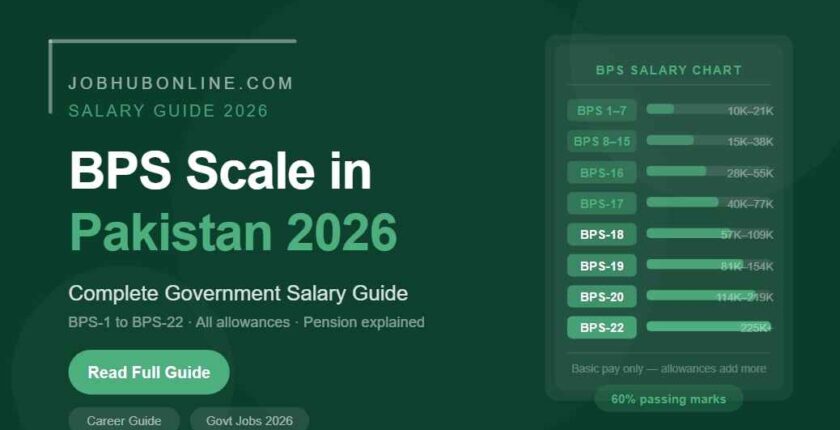
BPS Scale in Pakistan 2026 — Complete Government Salary Guide | Basic Pay Scales Explained
INTRO
One of the most common questions Pakistani job seekers ask — and rarely get a clear answer to — is what BPS actually means and what salary comes with each grade. You see “BPS-17” or “BPS-11” in every government job advertisement, but the advertisements rarely tell you what that translates to in actual monthly take-home pay.
This guide breaks it all down. What BPS means, how the pay scale system works, what salary you can expect at each grade, what allowances are added on top, and how your pay grows over time. Whether you are a fresh graduate considering your first government job or an experienced professional evaluating a career shift into the public sector, this is the information you need to make an informed decision.
What Is BPS? — Basic Pay Scale Explained
BPS stands for Basic Pay Scale. It is the standardised salary grading system used by the Government of Pakistan to categorise all federal government employees into numbered grades — from BPS-1 at the entry level to BPS-22 at the most senior positions.
Each BPS grade has:
- A minimum basic pay (the starting salary when you first join that grade)
- A maximum basic pay (the salary ceiling for that grade after annual increments)
- An annual increment amount (how much your basic pay increases each year)
Your BPS grade is determined by your qualification, the nature of the post you are appointed to, and the pay scale assigned to that specific position in the government’s service structure.
The basic pay is not your full salary. On top of the basic pay, government employees receive a range of allowances — house rent, medical, conveyance, and others — that collectively make up the total monthly package.
BPS Grades — Who Falls in Which Category?
The BPS system divides government employees into three broad categories:
Ministerial / Support Staff — BPS-1 to BPS-15
These grades cover support, clerical, and lower administrative staff. Positions like peon, naib qasid, driver, store keeper, data entry operator, UDC (Upper Division Clerk), LDC (Lower Division Clerk), assistant, and similar posts fall in this range.
Education requirements range from Primary Pass (BPS-1 to BPS-4) to Matric (BPS-5 to BPS-9) to Intermediate and Bachelor’s degrees (BPS-11 to BPS-15).
Officers — BPS-16 to BPS-20
These are officer-grade positions — the core professional and managerial tier of government service. Positions like Assistant (CSS), Inspector, Sub-Inspector, Junior Executive, Assistant Manager, Deputy Manager, Section Officer, Deputy Secretary, and equivalent roles fall here.
A 16-year Bachelor’s degree (4-year BS or equivalent) typically qualifies for BPS-16 entry. Senior positions up to BPS-20 require substantial experience and seniority.
Senior Management — BPS-21 and BPS-22
These are the most senior positions in the federal government — Additional Secretary, Federal Secretary, and equivalent grade officers. BPS-21 and BPS-22 positions are reached through long service, promotion, and seniority rather than direct recruitment.
BPS Scale Salary Chart 2026 — Complete Grade-by-Grade Breakdown
The following table shows the revised basic pay scales for federal government employees. Note that the exact figures are subject to annual budget announcements — the amounts below reflect the most recently revised pay scales:
| BPS Grade | Minimum Basic Pay | Maximum Basic Pay | Annual Increment | Typical Posts |
|---|---|---|---|---|
| BPS-1 | Rs. 10,258 | Rs. 15,514 | Rs. 338 | Naib Qasid, Sweeper, Sanitary Worker |
| BPS-2 | Rs. 10,688 | Rs. 16,220 | Rs. 357 | Chowkidar, Mali, Farash |
| BPS-3 | Rs. 11,152 | Rs. 17,020 | Rs. 386 | Cook, Daftri, Fireman |
| BPS-4 | Rs. 11,669 | Rs. 17,915 | Rs. 410 | Driver (Light), Carpenter, Painter |
| BPS-5 | Rs. 12,253 | Rs. 18,965 | Rs. 442 | Junior Clerk, Telephone Operator |
| BPS-6 | Rs. 12,907 | Rs. 20,127 | Rs. 478 | Cashier, Store Assistant |
| BPS-7 | Rs. 13,634 | Rs. 21,434 | Rs. 520 | Storeman, Junior Patrol Officer, Assistant Cook |
| BPS-8 | Rs. 14,441 | Rs. 22,901 | Rs. 564 | Senior Clerk, Dispatch Rider |
| BPS-9 | Rs. 15,334 | Rs. 24,544 | Rs. 614 | Assistant Store Keeper, Head Clerk |
| BPS-10 | Rs. 16,317 | Rs. 26,377 | Rs. 671 | Senior Assistant, Supervisor |
| BPS-11 | Rs. 17,397 | Rs. 28,413 | Rs. 734 | LDC, Junior Executive, Stenographer |
| BPS-12 | Rs. 18,581 | Rs. 30,661 | Rs. 805 | UDC, Senior Stenographer |
| BPS-13 | Rs. 19,877 | Rs. 33,137 | Rs. 886 | Assistant, Accountant |
| BPS-14 | Rs. 21,293 | Rs. 35,853 | Rs. 977 | Senior Assistant, Head Accountant |
| BPS-15 | Rs. 22,837 | Rs. 38,817 | Rs. 1,079 | Superintendent, Office Superintendent |
| BPS-16 | Rs. 28,227 | Rs. 54,677 | Rs. 1,783 | Officer (Entry Level), Inspector, Sub-Inspector |
| BPS-17 | Rs. 40,036 | Rs. 76,706 | Rs. 2,445 | Assistant, Section Officer, Junior Manager |
| BPS-18 | Rs. 56,847 | Rs. 108,747 | Rs. 3,467 | Deputy Manager, Deputy Director |
| BPS-19 | Rs. 80,660 | Rs. 154,260 | Rs. 4,920 | Director, Manager |
| BPS-20 | Rs. 114,455 | Rs. 218,855 | Rs. 6,983 | Deputy Secretary, Senior Director |
| BPS-21 | Rs. 162,395 | Rs. 310,595 | Rs. 9,911 | Additional Secretary |
| BPS-22 | Rs. 225,000+ | Rs. 400,000+ | Varies | Federal Secretary, Senior positions |
Your Total Salary Is More Than the Basic Pay
The basic pay figures above are only part of what a government employee receives. Federal government employees receive several allowances on top of basic pay:
House Rent Allowance (HRA)
The most significant allowance. Government employees who do not live in government-provided accommodation receive HRA calculated as a percentage of basic pay — typically 45% for employees posted in major cities.
Medical Allowance
A fixed monthly amount for medical expenses. The amount varies by grade.
Conveyance Allowance
For employees without government transport. Covers commuting costs.
Special Pay / Special Allowance
Many departments add special allowances specific to their sector — particularly in law enforcement, intelligence, revenue, and judiciary-attached departments.
Ad-hoc Relief Allowance
The federal government has periodically announced ad-hoc relief allowances — added as a percentage of basic pay — to partially compensate for inflation. Multiple ad-hoc allowances are currently active and add meaningfully to total pay.
What This Means for Your Total Package
As a rough guide, a federal government employee’s total monthly take-home package (basic pay + all allowances) is typically 1.8 to 2.5 times the basic pay. So a BPS-17 officer with a basic pay of Rs. 40,036 may have a total monthly package of Rs. 72,000 to Rs. 100,000 depending on posting location, department, and applicable allowances.
BPS vs MPS vs IPS — What Is the Difference?
You will notice that some government jobs — particularly in autonomous bodies and public sector companies — do not use the BPS system. They use alternative pay structures:
MPS — Management Pay Scales
Used by Punjab government for certain contract appointments. MPS-I and MPS-II are senior management grades used in Finance Department, Planning Department, and similar bodies. These typically offer higher cash salaries than equivalent BPS grades.
IPS — Integrated Pay Scales
Used by some autonomous bodies and public sector companies — particularly in the power sector (CPPA-G, DISCOs) and other federal corporations. IPS grades generally offer more competitive market-based packages than standard BPS.
PPS — Punjab Pay Scales
Punjab government’s own pay scale system, parallel to federal BPS but with provincial government-specific grade levels and amounts.
The key difference is that BPS is the federal civil service structure, while MPS, IPS, and PPS are used by specific provincial governments or autonomous entities with market-competitive pay mandates.
How Annual Increments Work
Each BPS grade has an annual increment amount — the fixed rupee amount by which your basic pay increases every year on your increment date (usually July 1).
For example, a BPS-17 officer starting at Rs. 40,036 basic pay receives a Rs. 2,445 increment each year. After 10 years of service at BPS-17 (assuming no promotion), their basic pay would be approximately Rs. 64,486 — plus all applicable allowances.
Promotions from one BPS grade to the next are separate from annual increments — they involve a more significant jump in basic pay and usually require time-in-grade criteria, performance evaluation, and departmental promotion processes.
Which BPS Grade Should You Target?
This depends entirely on your qualification:
| Qualification | Typical Entry BPS | Example Posts |
|---|---|---|
| Primary Pass | BPS-1 to BPS-3 | Support staff, naib qasid |
| Middle Pass | BPS-3 to BPS-5 | Junior support staff |
| Matric / SSC | BPS-5 to BPS-9 | Clerk, driver, storeman |
| Intermediate / FA / FSc | BPS-11 to BPS-14 | LDC, Junior Executive |
| 14 years education (BA/BSc) | BPS-14 to BPS-16 | Assistant, inspector |
| 16 years education (BS/BBA) | BPS-16 to BPS-17 | Officer-grade entry |
| Master’s degree / MS | BPS-17 to BPS-18 | Senior officer entry |
| PhD | BPS-18 to BPS-19 | Research/academic positions |
| Professional (CA/FCPS/etc.) | BPS-17 to BPS-19 | Specialist positions |
The jump between BPS-15 and BPS-16 is significant — it marks the transition from ministerial/clerical staff to officer cadre. This is why the 16-year education requirement (4-year Bachelor’s degree) is so commonly specified in government job advertisements — it is the gateway to officer-grade employment.
Pension — The Hidden Long-Term Value of Government Jobs
One of the most significant advantages of a BPS-based government career that most salary comparisons overlook is the pension.
Federal government employees who complete the minimum qualifying service (typically 25 years, or retirement at age 60 with minimum service) receive a monthly pension for life after retirement. The pension is calculated as a percentage of the last drawn basic pay.
In a private sector career, you would need to accumulate significant personal savings to generate equivalent monthly income after retirement. The government pension eliminates this need — it is a defined benefit that continues for the employee’s lifetime and, in many cases, continues for the spouse after the employee’s death.
When you calculate the true value of a government job over a 30-year career — factoring in job security, medical benefits, housing facility or HRA, and the pension — the total lifetime compensation of a BPS-17 federal officer is substantially higher than the monthly salary figure alone suggests.
Common Mistakes When Reading Government Job Salaries
Mistake 1 — Comparing basic pay to private sector CTC Private sector salaries are often quoted as “CTC” (Cost to Company) which includes employer EOBI contributions, health insurance, and other benefits. Government basic pay is just the base — total package including allowances is more comparable.
Mistake 2 — Ignoring the pension value A lifetime monthly pension is an asset worth millions of rupees in present value terms. Most private sector jobs offer no equivalent.
Mistake 3 — Not checking if the post is BPS or contract Many government and semi-government organisations now recruit on contract basis (3–5 year contracts) rather than permanent BPS appointments. Contract posts typically offer higher monthly packages but no pension and less job security. Always check whether a post is permanent BPS or contract before applying.
Mistake 4 — Assuming all BPS-17 jobs are the same Different departments at the same BPS grade have different working environments, growth prospects, and lifestyle implications. A BPS-17 position in a field posting is different from BPS-17 in a Islamabad-based ministry. Research the specific department and position, not just the grade.
Quick Reference — Most Common Government Job Grades
| Grade | Who Typically Gets It | Approx Total Package |
|---|---|---|
| BPS-7 | Matric with experience — Storeman, JPO | Rs. 30,000 – Rs. 45,000 |
| BPS-11 | Intermediate — Junior Executive, LDC | Rs. 40,000 – Rs. 55,000 |
| BPS-14 | Bachelor’s — Senior Assistant | Rs. 50,000 – Rs. 70,000 |
| BPS-16 | Bachelor’s — Entry Officer | Rs. 65,000 – Rs. 90,000 |
| BPS-17 | Master’s / 4-year BS — Section Officer | Rs. 90,000 – Rs. 130,000 |
| BPS-18 | Experienced Officer — Deputy Director | Rs. 130,000 – Rs. 180,000 |
| BPS-19 | Senior Officer — Director | Rs. 180,000 – Rs. 260,000 |
| BPS-20 | Very Senior — Deputy Secretary | Rs. 260,000 – Rs. 380,000 |
Note: Total package estimates include basic pay plus standard allowances. Actual amounts vary by department, posting location, and applicable special allowances.
Want to find current government jobs across all BPS grades? Browse our Govt Jobs section for the latest federal and provincial vacancies — updated daily.
✍️ Written by JobHubOnline Editorial Team
📅 Published: May 2026
🔄 Last Updated: May 2026
⏱️ 11 min read
Disclaimer
The salary figures in this article are based on the most recently revised federal government pay scales and are provided for general guidance only. Actual salaries may vary based on department, posting location, tenure, and applicable allowances. Always refer to the official gazette notification or the Finance Division, Government of Pakistan for the most current and authoritative BPS figures. jobhubonline.com is not affiliated with any government body.